
Guilhem Niot
Practical Information
How to get there
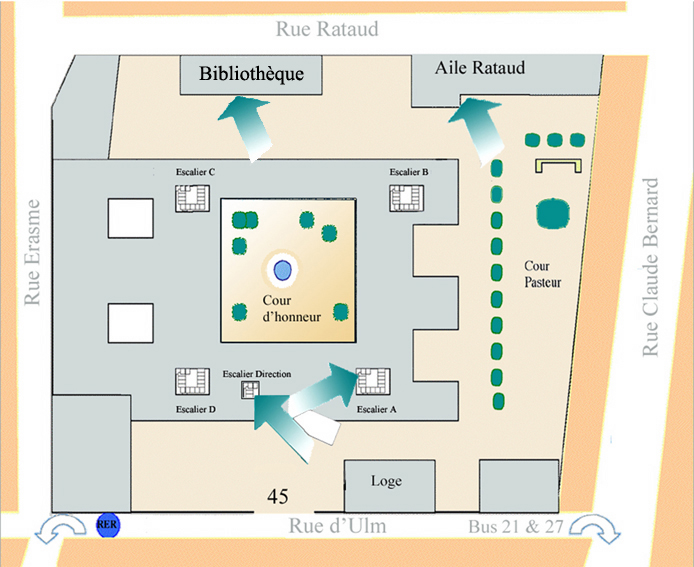
The defense will take place at École Normale Supérieure (ENS PSL), 45 rue d’Ulm, 75005 Paris - Google Maps.
By metro: Line 7 - Censier-Daubenton or Place Monge (5-min walk), RER B - Luxembourg (7-min walk)
By bus: Lines 21, 27 - stop Feuillantines
Room: Amphi “Evariste Galois” (NIR), level PB (basement). Once through the main entrance at 45 rue d’Ulm, cross the Cour d’honneur and head towards the library (Bibliothèque) at the back of the courtyard. Take the stairs or elevator down to level PB.
Jury
| Role | Name | Position |
|---|---|---|
| Reviewers | Damien Vergnaud | Professeur, Sorbonne Université |
| Vadim Lyubashevsky | Researcher, IBM Research Zurich | |
| Examinators | Dennis Hofheinz | Professor, ETH Zurich |
| Phong Q. Nguyen | Directeur de recherche, ENS PSL | |
| Katharina Boudgoust | Chargée de recherche, CNRS Montpellier | |
| Russell W. F. Lai | Assistant Professor, Aalto University | |
| Director | Pierre-Alain Fouque | Professeur, Université de Rennes |
| Co-director | Thomas Prest | Chercheur, PQShield |
About the Thesis
This thesis develops a toolkit for designing and deploying practical, lattice-based threshold signatures - a post-quantum alternative to classical threshold signing schemes.
Threshold signatures allow a group of participants to jointly produce a valid signature, providing resilience against faults and partial key compromise. While classical schemes are now mature and actively deployed, practical post-quantum constructions have remained an open challenge.
Three main contributions:
- Robustness: distributed key generation and signing that guarantee a valid signature even in the presence of malicious participants.
- Efficiency: a much more efficient protocol achieving identifiable aborts, detecting rather than preventing malicious behavior.
- Standard compatibility: the first practical threshold version of ML-DSA (Dilithium), the NIST post-quantum signature standard.
Extended Abstracts
Keywords: Threshold signatures, Lattices, Robustness, ML-DSA
Post-quantum cryptography has gained momentum in recent years, motivated by the threat that quantum computers pose to widely deployed classical public-key cryptography. While NIST has standardized several post-quantum public-key encryption and digital signature schemes, many advanced cryptographic primitives remain less well understood in the post-quantum setting. Among these, threshold signatures are particularly important: they enable a group of participants to jointly produce a valid signature, providing resilience against faults and partial compromise of the system.
Classical threshold signature schemes are mature and are getting widely adopted, but the development of practical post-quantum threshold signature schemes remains an open challenge. Proposed constructions often lack robustness against malicious participants, efficient distributed key generation, and compatibility with emerging standards.
This thesis develops a toolkit for designing and deploying practical, lattice-based threshold signatures. First, we establish a foundation for robustness, introducing techniques for distributed key generation and signing that guarantee the creation of a valid signature even in the presence of malicious participants. Next, we develop a much more efficient protocol that achieves identifiable aborts, a property that detects rather than prevents malicious behavior. Finally, we address standard compatibility by presenting the first practical threshold version of ML-DSA (Dilithium).
Mots clés : Signature à seuil, Réseaux euclidiens, Robustesse, ML-DSA
La cryptographie post-quantique a gagné en importance ces dernières années, motivée par la menace que les ordinateurs quantiques font peser sur les systèmes cryptographiques classiques. Bien que le NIST ait standardisé plusieurs schémas de chiffrement à clé publique et de signature numérique post-quantiques, il subsiste un fossé important dans notre compréhension des primitives cryptographiques avancées dans ce contexte. Parmi celles-ci, les signatures à seuil se distinguent comme une primitive particulièrement importante ; elles permettent à un groupe de participants de produire conjointement une signature valide, offrant ainsi une résilience face aux défaillances et au compromis partiel.
Alors que les schémas de signature à seuil classiques ont atteint un stade de maturité et sont déployés, le développement de schémas de signature à seuil post-quantiques pratiques demeure un défi ouvert. Les constructions proposées manquent souvent de robustesse face aux participants malveillants, d'une génération de clé distribuée efficace, et de compatibilité avec les standards émergents.
Cette thèse fournit une boîte à outils complète pour la conception et le déploiement de signatures à seuil pratiques basées sur les réseaux euclidiens. Premièrement, nous établissons les fondations de la robustesse, en introduisant des techniques de génération de clé distribuée et de signature qui garantissent la création d'une signature valide même en présence de participants malveillants. Ensuite, nous nous tournons vers un protocole radicalement plus efficace, permettant l'identification des abandons (identifiable aborts), une propriété qui permet de détecter les comportements malveillants plutôt que de les prévenir. Finalement, nous présentons de nouvelles idées pour répondre au défi de compatibilité avec les standards, en présentant la première version à seuil pratique de ML-DSA.
In-person attendance
If you plan to attend in person, please fill in the form below so we can plan the meal afterwards.